Acrylic on Canvas
Mar’s creative work is entirely self-taught, and most often done out of love. Materials are always the cheapest, coupon-stacked acrylic paint, brushes, and canvases. The photos of these pieces are taken by a phone camera, so the texture is not as clear, but all pieces have texture.
“I Feel [Timeless] Love”
Acrylic on Canvas
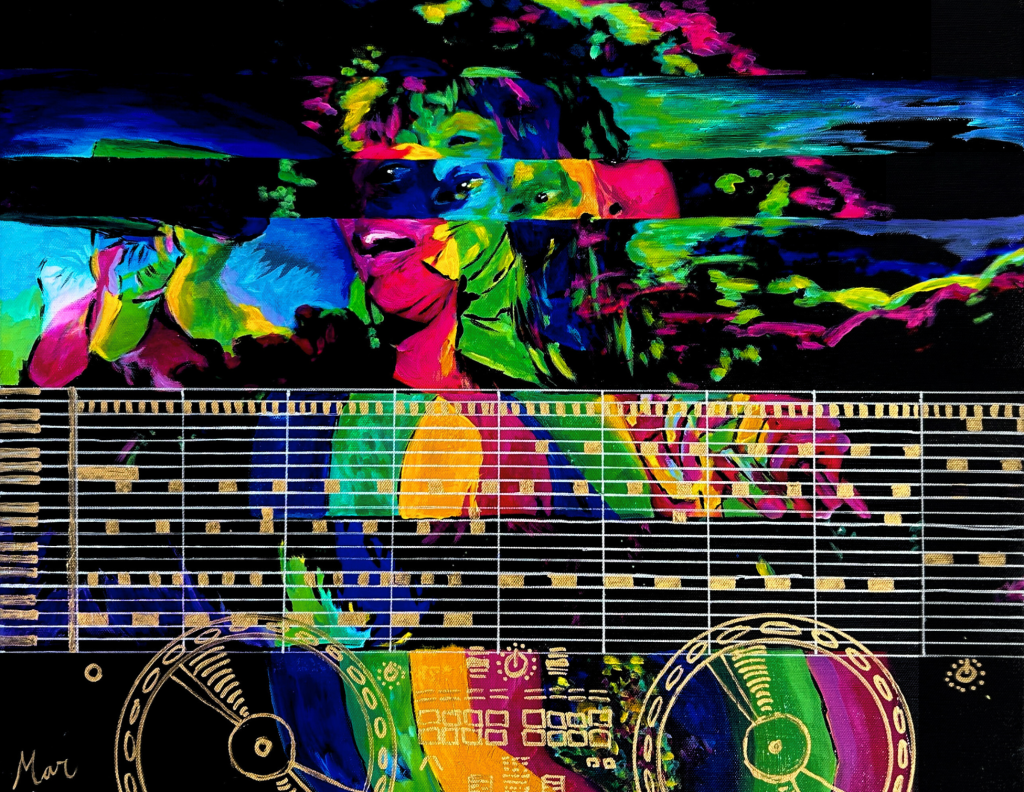
Like all of my works, I was inspired by the things that inspire the people I love. This is a tribute to Disco, Donna Summer, and their description of it:
“Well the beautiful thing about disco is the ‘galloping bass-line’— which is the term for when dance music uses a repeating beat to lull you into a sense of timelessness. The best example is Donna Summer’s I Feel Love, and almost all disco hits were made by Black women, which means that for this brief moment in time Black women’s voices governed people’s experience of time”
I chose the overlapping images of an older Donna Summer and a young Donna Summer, and they are overlapping in opposite directions (young Donna goes cool to warm, older Donna goes warm to cool). Also, the eyes of young Donna have three different emotional expressions (sadness, hope, and fear, in that order), and older Donna expresses joy. In an attempt to replicate the sense of timelessness, I layered the literal galloping bass-line of I Feel Love over the destabilized chronology of Donna’s affective lifespan.
The gold, like in my other works, symbolizes 1) something that is sacred and 2) something that seem good in the most obvious ways, but is more complicated. Here it’s the misleadingness of time, and how the repeating bassline (in a literal depiction of it) leads the listener into a sense of timelessness, but arguably, also urgency.
“Joyful Protest: Salsa in Movement”
Acrylic on Canvas
Dedicated to Playful Protest: The Political Work of Joy in Latinx Media, evolved from the dissertation [title] “Salsa Epistemology.”
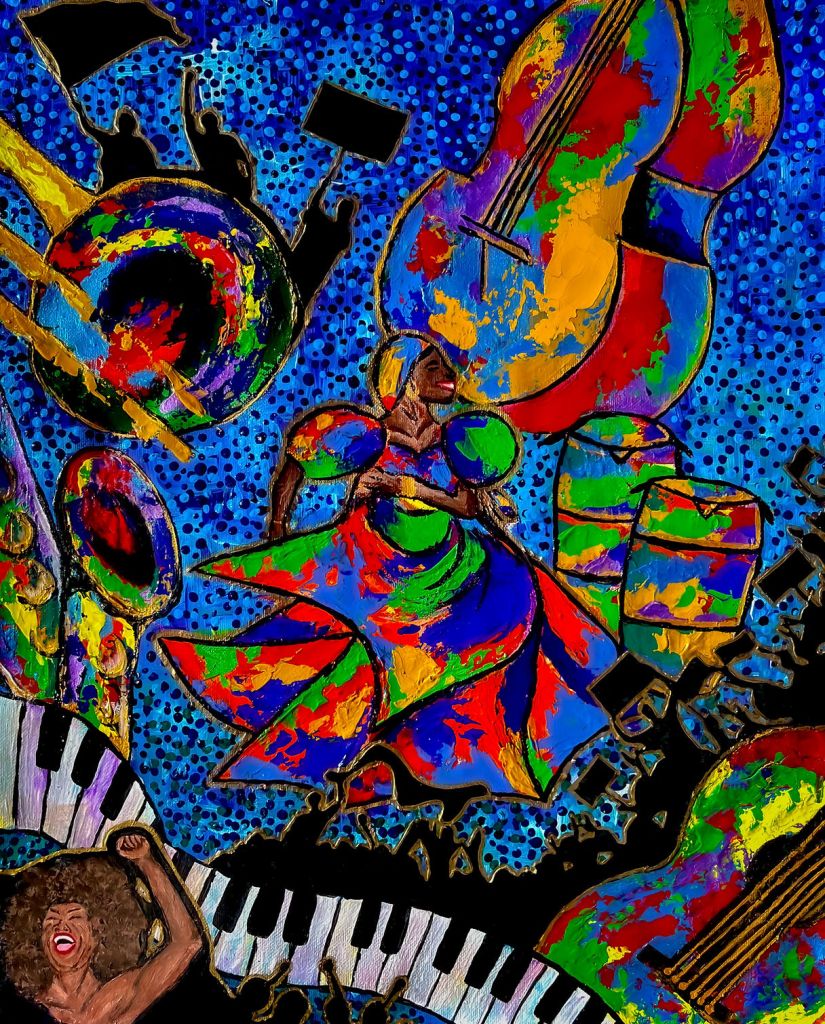
In an effort to embrace contradictions, outlining things in gold symbolizes 1) something that is sacred (as gold outlines are often used in religious iconographies, and this is my personal queer reclaiming of gold), but also 2) something that is misleading—in reference to gold in the King Midas tale, but also to Spanish ships sinking in the Atlantic, carrying (too) heavy loads of gold and silver. Things that seem good in the most obvious ways (like turning things to gold/carrying weight in gold, or in this case, the boldness of joy in protest), often carry loneliness, sorrow, grief and pain under them (the grief/loss that accompanied that violent colonial extraction, and in this case, the spectacular, chronic, and quotidian loss accompanied by the oppression that inspires resistance). I thought it was fitting, as joy in protest is not without grief and anger (as expressed in the book).
The blue in the painting also embraces contradiction; blue is often used to symbolize sadness, but also happiness and clarity (e.g. “clear/ blue skies”), or even spontaneity (if you think about jazz). The reflection of the sky on the ocean is what makes it appear blue, and a calmness in the sky paints the ocean blue. Simultaneous grief and joy like in my own handcrafted Lapis lazuli necklace, that I never take off, gifted to me by my late grandfather (Martin, whom I’ve named myself after). Interestingly, the sky (so often used to symbolize our emotions) is blue because blue has a short wavelength, making it the most scattered light in the atmosphere. Blue is so ubiquitous because it creates infinite reflections of itself, perhaps most obviously on the color of the sea (also reminiscent of my name).
I encapsulated the joy/movement of this painting (the movement of the dancer and the musical instruments, and the movement actors) in gold—a precarious, sacred blend of grief, anger, and joy. And I place them in shades of blue, because political opportunity structures are reflections of culture, and culture is a reflection of political contexts. Joy has to come from somewhere in order for it to exist everywhere. Protest is exhausting, and if joy didn’t exist anywhere, we would have stopped a long time ago.
“Burning Red: Joy, Rage, and Activism”
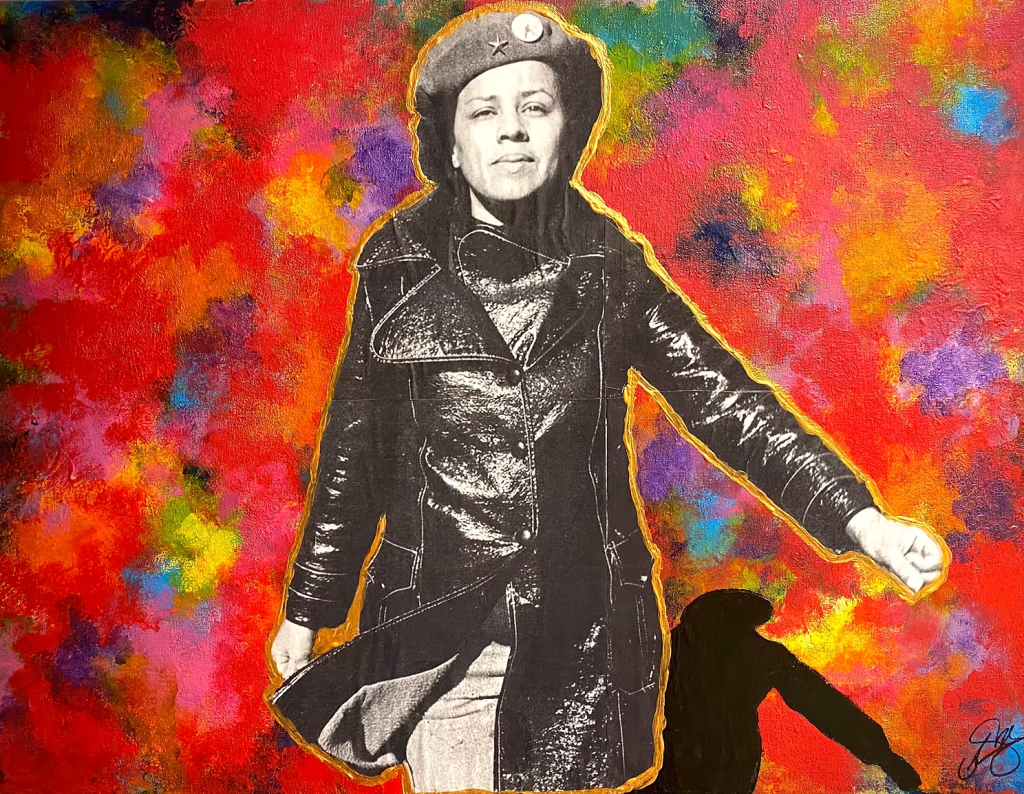
Mixed Media, Print Lacquer, Acrylic on Canvas
Dedicated to “Joy, Rage, and Activism,” an article that examines the integral role of affect in feminist and decolonial social movements and the strategic interplay between two affective modes, rage and joy—visually, I saw them as “red” affects (joy/erotic, rage/anger). Soares extends Audre Lorde’s work on the Uses of Anger and the Uses of the Erotic, with precise anger/rage and erotic/joy functioning as a “lifeforce” in these movements. I see them in burning red.
The article opens with a description of Iris Morales “smiling exultantly” in El Pueblo Se Levanta, as symbolic of the joy/rage behind the traditional, serious depictions of protest—including the film’s cover image. I used that cover image in the foreground, and set the “burning red” as the background [and sociopolitical context] of the painting.
I’ve always been afraid to use red in paintings because I think it drowns out other colors (mostly because the red of the acrylic paint I can afford literally drowns out the pigment concentration in the other colors), but I thought that if I was deliberate about it, that it could work to make the other colors come together in the same way this article describes how joy/rage have to be used precisely in activism. I could have bought more expensive paint, but I didn’t. I made it work with what I had because you can’t change a political opportunity structure, but you can navigate its structural inequities (of paint pigment and white supremacy).
The gold here, again, is a queer reclamation of the use of gold in religious iconographies; paintings, statues, altars. Gold is used in religious iconographies, especially Christian ones, not just because of its market value, but because of it’s biblical value as a symbol of purity, heaven, nobility, and superiority. A queer reclamation of a gold dressing means redefining what is worthy of that protective encasing. Growing up Catholic, with cheap, bodega-laminated religious icons in my juvenile wallet meant hearing homophobic condemnations alongside virtue signals. Now, as a queer and trans adult, and especially as an artist and theorist, I get to redefine divinity and righteousness. To me that means granting divinity to the extraordinary, quotidian (queer) disobediences to hegemony.
“treading freshwater“

Acrylic on Canvas
Dedicated to Freshwater by Akwaeke Emezi.
Patchy vertical strokes of deep royal blue on the left half and florals on the right. Half of a golden snake swims in the blue; half a boredom-struck countenance hides in golden lines through the florals. I painted it soon after reading Freshwater (by Akwaeke Emezi), which was the first time I stopped trying to untangle my transness from my mental illness, from my fractured reality and PTSD, from my untamed emotions. The beautiful writing in Freshwater is unlike anything I’d read before, and I painted this without much conscious thought. In this frozen, pre-transition state of mostly-survival, Freshwater just makes sense in a way I cannot explain with words.
 Mar Galvez Seminario